

TL;DR: Your online reputation can shape what people think before they ever contact you. To learn how to improve online reputation, focus on honest reviews, useful content, quick responses, and a clear brand voice.
Ryan Reynolds sells more than movies.
He sells ideas, products, and brands. And he does it with a voice people recognize. From Aviation Gin to Mint Mobile, Reynolds has turned his public image into part of his marketing. TIME reported in 2025 that his company, Maximum Effort, uses storytelling and humor to make brands feel more human.
That raises an important question for every business: What do people see when they search for you?
A great website helps. So do good reviews. But one angry comment, an old post, or a confusing search result can change the picture fast. Learning how to improve online reputation means taking control of that picture before someone else defines it for you.
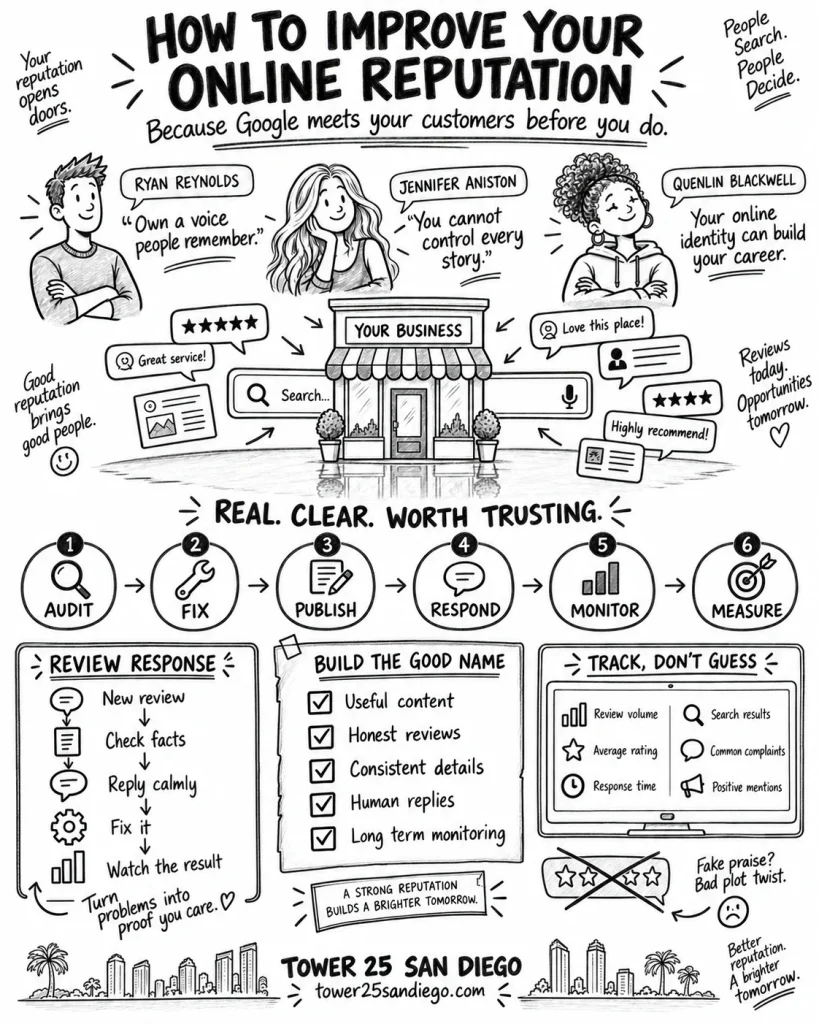
Why Reputation Management Is Important Before Customers Call
Think about your last online search.
Did you call the first business you found?
Probably not.
You may have checked its website, Google reviews, social media, photos, and customer comments first. Your customers do the same thing.
A 2025 Harvard Business Review study by Subhash Jha, Abhijit Biswas, and Prashanth Ravula analyzed more than 110,000 online reviews to understand what makes reviews persuasive. The researchers found that the power of a review depends partly on how often consumers expect to buy the product or service. In simple terms, people do not read every review in the same way. The nature of the purchase can change how much weight they give to what other customers say.
That matters for your business.
If someone is choosing a service they may use often, they may look at reviews differently than they would for a rare or expensive purchase. Either way, reviews can shape the picture a potential customer builds before making contact.
So, ask:
- What appears when people search your name?
- Are your latest reviews positive, mixed, or negative?
- Does your website answer basic questions?
- Do your social profiles look active?
- Does your brand sound the same everywhere?
These are not small details. They shape first impressions.
What Ryan Reynolds Gets Right About Brand Reputation
Ryan Reynolds gives businesses an interesting lesson: people remember a voice.
Eliana Dockterman, a correspondent of TIME, explains how Reynolds carries his storytelling style from Hollywood into advertising. His Maximum Effort team creates fast, humorous campaigns that match his recognizable personality. Dockterman also noted that his social media presence is carefully tuned to his public image.
But why does that matter?
Think of a company whose website sounds formal, whose Instagram sounds silly, and whose customer service replies sound cold. What does the customer believe?
A mixed message creates doubt.
Reynolds shows the value of having a clear voice. A business does not need to copy his humor. It needs to know what it wants people to remember.
Your brand might be friendly. It might be expert. It might be bold. It might be local and personal.
Pick the voice. Then use it consistently.
That is a key part of “how to improve online reputation.” You are not only managing bad reviews. You are giving people a clear reason to trust you.
How to Manage Google Reviews Without Making Things Worse
A bad review can feel personal.
Should you fight back? Delete it? Ignore it?
Take a breath first.
Tower 25 San Diego’s reputation management process starts with an audit, then cleanup, boosting positive content, and defending the brand through ongoing monitoring.
A simple process looks like this:
New review → Read carefully → Check the facts → Respond calmly → Fix the problem → Monitor the result
Why does this matter?
Because fake or manipulated reviews can hurt trust. A 2025 study in European Management Review examined 48 interviews with people involved in creating falsified reviews and found that psychological distance can shape how people create those reviews.
Another 2025 study analyzed more than 714,000 reviews and found that AI-generated fake reviews show patterns that differ from both human-generated fake reviews and authentic reviews.
The lesson is simple: do not try to manufacture a perfect reputation. Build a real one.
If a customer complains about slow service, do not write a fake five-star review to bury it. Find out why the service was slow. Fix the process. Then invite real customers to share honest feedback.
What Jennifer Aniston & Quenlin Blackwell Show Us
Hollywood shows another side of reputation: you cannot control everything people say about you.
Jennifer Aniston has spoken about the changing nature of public scrutiny and the problems created by social media and deepfake images. Her experience shows how quickly a public image can move beyond the person’s own control.
Quenlin Blackwell offers a different example. She has built a large audience through social media and has moved into mainstream entertainment. Her online identity is not separate from her career. It helped create it.
Both examples point to the same question: What happens when other people control the story people see about you?
You cannot stop every post.
You cannot make every customer happy.
You cannot remove every criticism.
But you can create more accurate, useful, and positive information around your brand.
That is why content matters. At Tower 25 San Diego, our content strategy focuses on blogs, videos, photos, graphics, SEO, and content planning with a clear purpose.
A useful blog can answer a customer question. A helpful video can explain a service. A strong customer story can show what your business does well.
Each piece adds context.
What Are the Best Ways to Build a Positive Online Reputation?
Publish Useful Content
Do not publish just to stay active.
Answer questions your customers ask. Explain confusing topics. Show your process. Share useful tips.
Good content can help people find you and understand you.
Ask for Honest Reviews
Happy customers often need a simple reminder to leave feedback.
After a successful purchase or service, ask them to share an honest review. Do not offer fake praise or pressure them to give a specific rating.
Research published in 2025 continues to show that online reviews play an important role in trust and buying decisions.
Keep Your Information Consistent
Check your business name, phone number, address, hours, services, photos, and social profiles.
Why make customers guess?
If Google says you close at 6 p.m. but your website says 8 p.m., someone may lose trust before they ever call.
Respond Like a Human
A customer does not want a robotic reply.
Thank people for good feedback. For complaints, acknowledge the issue, avoid an argument, and offer a way to solve the problem.
Build a Long-Term Strategy
Reputation management should not begin after a crisis.
Monitor reviews. Watch mentions. Track search results. Publish useful content. Keep your social pages active. Review what customers say about you.
That creates a brand reputation management strategy instead of a last-minute rescue plan.
How Do You Know If Your Reputation Is Getting Better?
You need more than a feeling.
Track simple signs:
| What to track | What it tells you |
| Review volume | Are more customers talking about you? |
| Average rating | Is customer sentiment changing? |
| Review response time | Are you handling issues quickly? |
| Search results | What do people see first? |
| Website traffic | Are people finding your content? |
| Common complaints | What problems keep appearing? |
| Positive mentions | What do customers like most? |
A 2025 study in Information Systems Research also examined how people judge whether reviews are genuine. The researchers found that people can show a “truth bias,” meaning they may treat information as truthful even when they do not know whether it is real.
That makes your job even clearer.
Give people reliable information.
Do not wait for a crisis to start building trust.
Key Takeaways
- Your online reputation starts before a customer contacts you.
- Ryan Reynolds shows how a clear and consistent voice can strengthen a brand.
- Never use fake reviews to hide real problems.
- Respond to negative reviews calmly and look for patterns.
- Use reviews, SEO, content, social media, and monitoring together.
- Measure your reputation instead of guessing how people see you.
Make Your Good Name Easier to Find
So, how do you improve online reputation in a world where anyone can post about your business?
Start with what customers see.
Fix outdated information. Answer reviews. Publish useful content. Keep your message consistent. And watch for problems before they become crises.
Your reputation does not need to be perfect. It needs to be real, clear, and worth trusting.
That is exactly where Tower 25 San Diego can step in. Its reputation management service monitors platforms such as Google, Yelp, and Reddit, helps businesses respond to difficult reviews, builds positive customer feedback, and provides ongoing reputation protection.
Ready to build a reputation that works for your business instead of against it? Get your free SEO Audit today and start turning your online presence into a source of trust, credibility, and growth.